
Using an NRC without its mounting can cost you a false comparison, a specification that the installed acoustic wall panels cannot substantiate, and avoidable redesign. Read the rating alongside the panel thickness, rear spacing and backing: ASTM E795’s public description says mounting affects absorption, and Armstrong’s Tectum documents show different ratings for different assemblies of the same panel thickness.
What the four-band number means
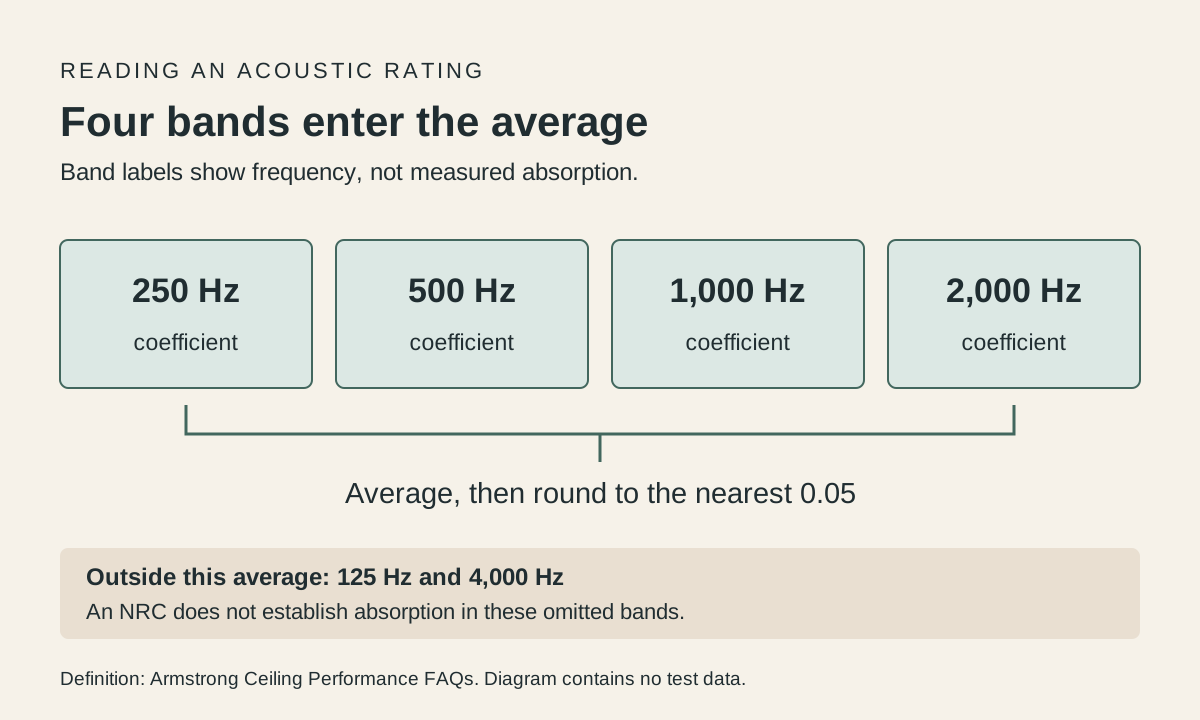
Armstrong’s Ceiling Performance FAQs define the Noise Reduction Coefficient as the average of absorption coefficients at 250, 500, 1,000 and 2,000 Hz, rounded to the nearest 0.05. The definition covers wall panels as well as ceilings and references ASTM C423. Written as a formula:
NRC = round to the nearest 0.05 of (α250 + α500 + α1000 + α2000) / 4
Here α is the absorption coefficient for the indicated frequency in hertz. Both the coefficients and NRC are dimensionless. In this definition, 125 Hz and 4,000 Hz do not enter the average; an NRC alone therefore leaves those bands unresolved. Different sets of coefficients can also produce the same rounded result. That is a consequence of averaging, rather than evidence that two named panels have been tested here.
The public ASTM C423 page describes measuring sound absorption through decay in a reverberation room. Its significance section cautions that practical sound fields and effective absorption differ from laboratory conditions. A panel’s NRC alone cannot establish a room decibel drop, reverberation time, panel quantity or speech privacy. For the room surfaces around the panel, see cafe acoustics and surfaces.
One panel thickness, four reported mountings
The acoustical-information block on page 3 of Armstrong’s Tectum Direct-Attach wall data sheet, BPCS-5716-526, reports the values below for 1-inch standard Tectum Direct-Attach panels. They are an example of how to read an assembly, rather than a recommendation or values for acoustic wall panels generally. They do not describe the separate High NRC product or another thickness.
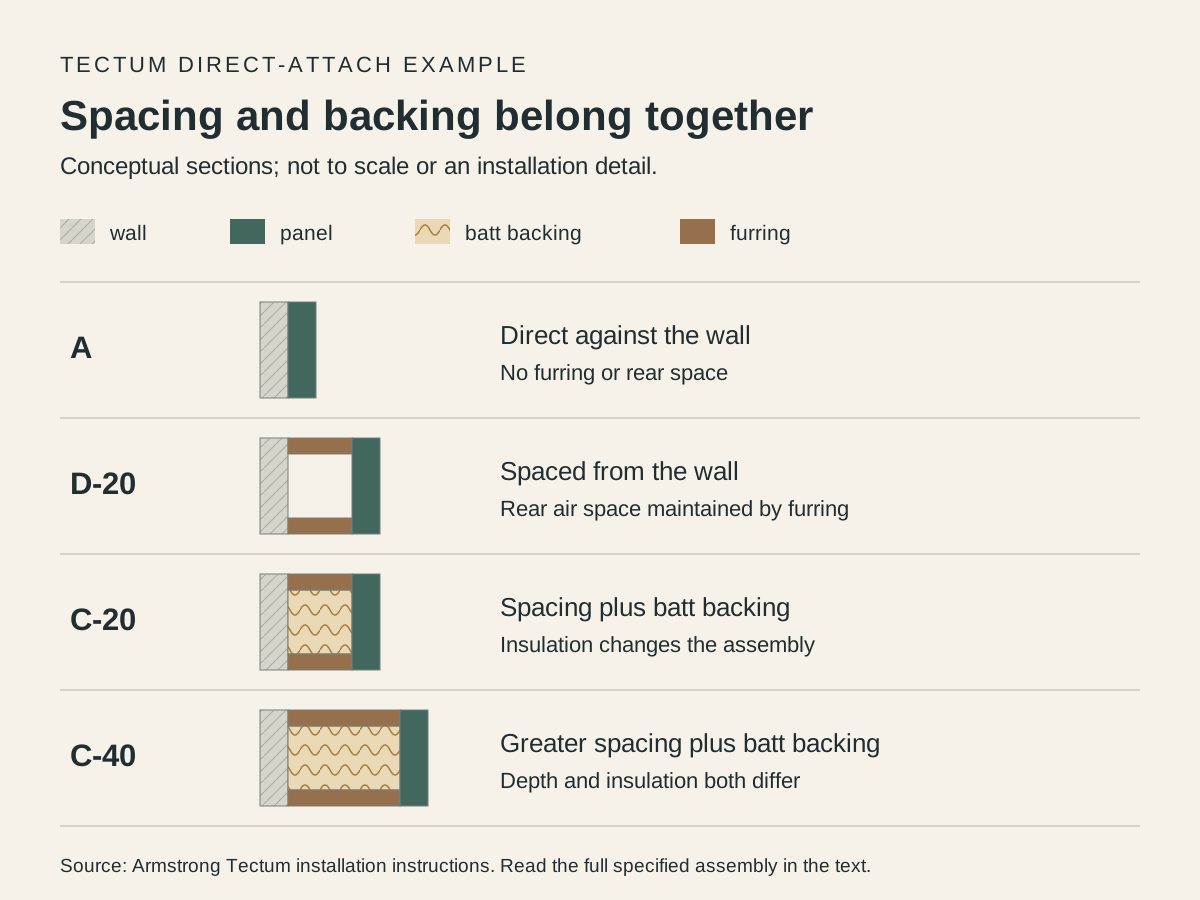
The mounting descriptions come from sections 4.1–4.4, pages 5–7, of Armstrong’s installation instructions, BPLA-298661-626. These are descriptions within that manufacturer’s system, not a universal decoding of mounting designations.
| Reported mounting | Assembly described in the Tectum instructions | NRC: 1-inch standard panel | Dominant Failure Mode | Prevention |
|---|---|---|---|---|
| A | Directly against the wall; no furring or rear space | 0.40 | Assigning a spaced assembly’s rating to direct attachment | Keep the A value attached to its direct mounting. |
| D-20 | 3/4-inch furring maintaining a rear air space | 0.45 | Omitting the specified spacing while retaining its rating | Check the rear space against the reported assembly. |
| C-20 | 3/4-inch furring with 1-inch fiberglass batt between the furring | 0.80 | Crediting the result to an air gap while omitting the batt | Match both the furring and the insulation specification. |
| C-40 | 1-1/2-inch furring with 2-1/2-inch batt between the furring | 0.85 | Transferring this value to a shallower or differently backed assembly | Retain the specified depth and batt; seek evidence for substitutions. |
The four input coefficients were not on the Tectum sheet, so this example is not recomputed.
Notice that the C mountings change the insulation as well as the spacing. These documents do not isolate the contribution of an air gap, so the higher values cannot be credited to spacing alone. Nor do they provide a correction factor for a different build-up.
Rule of thumb: if the installed backing, depth, or insulation differs from the reported mounting, the printed NRC does not establish the new assembly.
The public ASTM E795 page supports keeping material and mounting together. It also warns that some laboratory fixtures or deviations are unsuitable as practical installation specifications. A mounting code on a report does not replace the manufacturer’s complete installation instructions or a project fixing design.
Read the sheet, then identify the missing report fields
Start with the product and thickness. Keep the reported NRC next to its mounting designation, and read the relevant installation description for spacing and backing. Then look for a frequency table and a laboratory report that identifies the tested specimen. A data sheet can make a rating visible without supplying the information needed to audit the test.
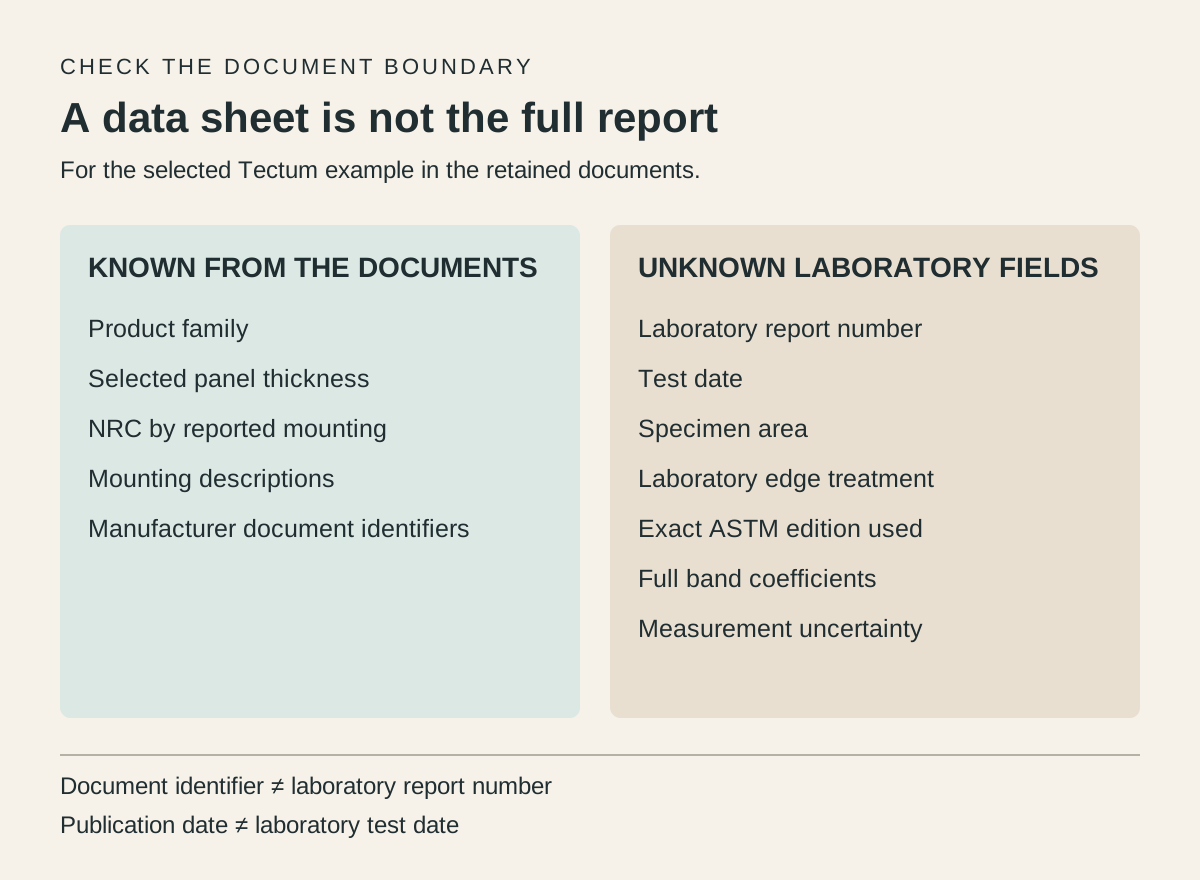
For this Tectum example, the retained documents establish the product family, the selected thickness, the four reported ratings and mounting descriptions. Their document identifiers are also known. The laboratory report number, test date, specimen area, laboratory edge treatment, exact ASTM edition used for those values, full band coefficients and measurement uncertainty belong to the full laboratory test report. A document identifier is not a laboratory report number; the date a source was accessed is not its test date.
For a bass concern, the missing band table matters: the four-band summary cannot establish performance at an omitted frequency. For sound passing through a partition, absorption is a different question from transmission; Armstrong’s FAQ describes STC as a barrier transmission rating. NRC also supplies no fire rating, structural fixing approval, impact rating, cleaning approval or preservation approval. Those decisions need their own evidence.
One further reading trap is treating a coefficient above unity as automatically impossible. ASTM C423’s public significance section explains that finite-specimen diffraction can raise apparent coefficients above unity. By the four-band calculation, an average can consequently exceed unity too; that inference concerns the measurement convention, not absorption of more energy than exists or proof of a superior installed room.
The useful next document is the laboratory report tied to the proposed assembly, with its frequency table, specimen details and mounting description. Until those fields are available, preserve the published values with their stated conditions and leave the missing fields unresolved.
Source scope
This technical review compares the five primary ASTM and manufacturer documents listed below. The ASTM sources are public scope and significance pages; the formula follows Armstrong’s FAQ, and the product comparison stays within the selected 1-inch Tectum data-sheet block and the accompanying manufacturer instructions.